

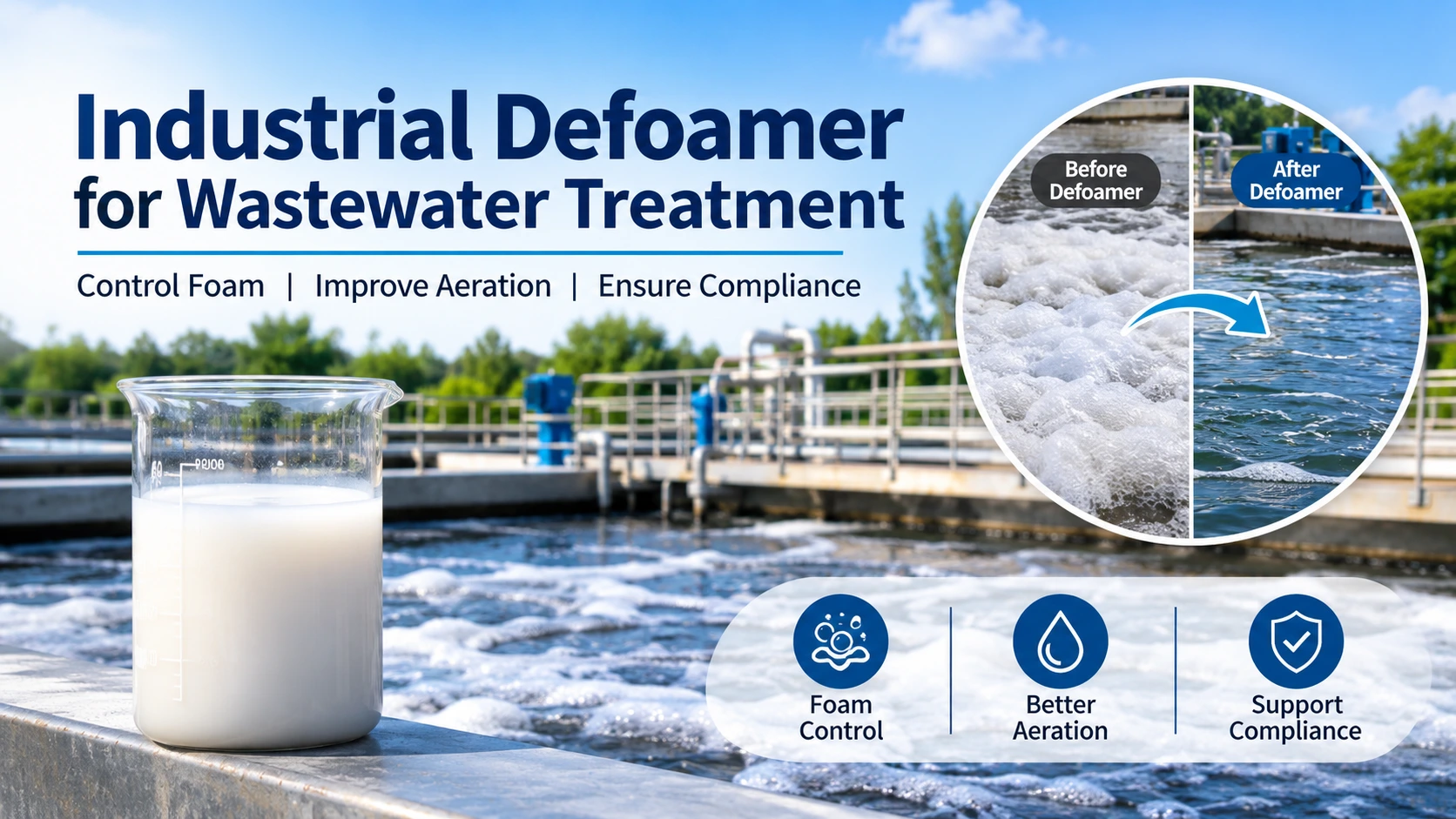
Defoamers for Wastewater Treatment: Meeting Aeration Efficiency Without Compromising Compliance
Key Highlights
- Excessive foam can interfere with aeration, process control, and plant operations.
- Foam may result from surfactants, low MLSS, filamentous organisms, high aeration and other process conditions.
- A suitable anti foaming agent can help control foam without replacing proper wastewater process control.
- Defoamer selection should consider water chemistry, pH, temperature, foam type, dosage and downstream treatment.
- The right industrial defoamer should control foam while limiting unwanted effects on biological treatment and treated water quality.
- Compliance depends on the overall treatment process and applicable discharge limits, not on defoamer use alone.
Why Foam Becomes a Problem in Wastewater Treatment
Foam is common in many wastewater treatment systems, especially where aeration and biological treatment are involved. Some foam is not a serious concern. However, excessive build-up can affect plant operation.
In an activated sludge system, air is supplied to the aeration tank to support biological activity. This creates strong mixing and gas-liquid contact. Under certain conditions, these actions can produce persistent foam.
The US Environmental Protection Agency notes that foaming can occur in aeration basins during start-up, particularly when MLSS is low and aeration is high. Surfactants and other substances in wastewater can also contribute to foam formation.
The problem can become more serious when foam:
- Overflows from the aeration tank
- Carries solids towards other areas
- Creates housekeeping problems
- Interferes with visual process monitoring
- Causes equipment or walkway contamination
- Affects stable plant operation
This makes foam control solutions an important part of process management where persistent foam is present.
New to defoamer chemistry? Our beginner’s guide explains how anti foaming agents work and why foam forms.
What Causes Foam in an Aeration Tank?
Foam does not always have one single cause. The source should be identified before selecting a defoamer chemical.
Common causes include:
| Cause | How It Can Contribute To Foam |
| Surfactants | Stabilise air bubbles and make foam more persistent |
| High aeration | Increases air-liquid mixing and bubble formation |
| Low MLSS | Can occur during start-up or process imbalance |
| Filamentous organisms | Can promote stable biological foam |
| High sludge age | May contribute to certain types of brown foam |
| Industrial contaminants | Can alter the surface properties of wastewater |
| High organic loading | Can disturb biological process conditions |
EPA process-control guidance identifies different types of aeration-tank foam and links them with factors such as MLSS, sludge age, F/M ratio and aeration conditions.
Therefore, adding a chemical should not be the first response to every foam problem. Operators should first check whether the issue comes from aeration, sludge control, influent changes or biological conditions.
How Defoamers Support Aeration Efficiency
Aeration is a key part of many biological wastewater treatment systems. It supplies oxygen and supports mixing.
The challenge is to maintain suitable dissolved oxygen without wasting energy. EPA guidance notes that poor aeration control can affect treatment performance, while excessive aeration can increase energy use.
Foam adds another operational challenge.
A suitable industrial defoamer can destabilise foam films and help release trapped air. This can reduce excessive surface foam while allowing operators to maintain the required aeration conditions.
However, a defoamer should not be used to compensate for poor aeration control.
A better approach is:
- Identify the source of foam.
- Check dissolved oxygen.
- Review MLSS and sludge age.
- Inspect influent characteristics.
- Check for surfactants or process contaminants.
- Select a compatible anti foaming agent.
- Establish the lowest effective dosage.
- Monitor the treatment process after dosing.
This provides better control than simply increasing the chemical dose whenever foam appears.
Choosing The Right Defoamer for Wastewater
Different wastewater streams have different chemical characteristics. A product that works well in one plant may not perform in another.
Common defoamer categories include silicone-based, mineral oil-based and non-silicone formulations. Classic Solvents lists mineral oil-based grades for wastewater treatment and non-silicone options for sensitive water-treatment systems.
When evaluating defoamer suppliers in India, industrial buyers should consider the following factors.
Foam Type
Is the foam light and temporary or thick and persistent?
The answer can influence the type and dosage of defoamer required.
Water Chemistry
pH, dissolved salts, surfactants, oils and organic matter can all affect performance.
Temperature
Treatment systems may operate under different temperatures. The chosen product should remain stable under actual operating conditions.
Dosage
Overdosing can increase costs and may introduce unnecessary chemical loading. The aim should be effective control at the lowest practical dose.
Biological Compatibility
Biological treatment relies on microorganisms. Any defoamer chemical used in the process should therefore be evaluated for its effect on the biological system.
Downstream Requirements
The treatment process may include clarification, filtration, membrane treatment or discharge. The selected product should be assessed for its effect on these downstream stages.
Silicone Vs Non-Silicone Defoamers
One of the common questions for industrial buyers is whether silicone-based chemistry is always the best choice.
It is not.
Silicone-based products can provide strong foam knockdown at relatively low concentrations. They may suit certain demanding industrial systems.
Non-silicone and mineral oil-based products can be useful where specific compatibility, process or downstream requirements make them a better fit.
| Factor | Silicone-Based | Mineral Oil-Based | Non-Silicone |
| Foam knockdown | Often high | Good in suitable systems | Depends on formulation |
| Typical use | High-performance systems | Wastewater and industrial processes | Sensitive water-treatment applications |
| Dosage | Often low | Application dependent | Application dependent |
| Compatibility | Must be tested | Must be tested | Useful for selected systems |
| Selection priority | Fast and strong control | Cost and process fit | System sensitivity |
The correct choice should always be based on plant trials and process conditions rather than the product category alone.
Can Defoamers Affect Wastewater Compliance?
This is one of the most important considerations.
Using a defoamer does not automatically make wastewater compliant. Compliance depends on the complete treatment system and the discharge requirements that apply to the facility.
For example, CPCB’s general effluent standards include parameters such as pH, suspended solids, oil and grease, BOD and ammoniacal nitrogen. The applicable limits can vary according to the discharge route and industry.
This means a defoamer should be assessed as part of the entire treatment process.
Before full-scale use, plants should review:
- Effluent quality
- BOD and COD
- Suspended solids
- pH
- Oil and grease where relevant
- Biological activity
- Sludge settling
- Downstream filtration
- Applicable regulatory limits
The product should also have suitable technical and safety documentation.
For industrial plants, defoamer suppliers in India should be able to provide clear information about product characteristics, recommended use and handling requirements.
How To Use Defoamers Without Overdosing
More chemical does not always mean better foam control.
An excessive dose can increase operating costs and may create unwanted interactions within the treatment system. The better approach is controlled dosing.
A practical dosing strategy can include:
Start with a small trial dose:
Test the product under actual process conditions.
Observe foam response:
Check how quickly the foam collapses and whether the effect lasts.
Monitor treatment performance:
Review dissolved oxygen, sludge behaviour and effluent parameters.
Adjust gradually:
Increase or reduce the dose based on measured results.
Automate where suitable:
Continuous or triggered dosing can help maintain more consistent foam control in plants with changing loads.
The goal is not to eliminate every visible bubble. The goal is to control excessive foam without disturbing the treatment process.
What Should Industrial Buyers Ask Defoamer Suppliers?
Selecting a supplier is as important as selecting the chemical.
When comparing defoamer suppliers in India, buyers can ask:
- Is the product suitable for wastewater treatment?
- What type of foam does it target?
- Is it silicone-based or non-silicone?
- What is the recommended starting dosage?
- How does it behave at the plant’s pH and temperature?
- Has compatibility with biological treatment been assessed?
- What happens after the treatment stage?
- Can the supplier support plant trials?
- Are technical and safety documents available?
- Can supply remain consistent at the required scale?
These questions help move the decision away from price alone.
Reliable foam control solutions should balance performance, process compatibility, dosage and operating cost.
When comparing antifoam manufacturers, industrial buyers should look for consistent product quality, clear technical specifications and application support.
Experienced antifoam manufacturers can also help with product trials and dosage optimisation based on the wastewater system.
A Practical Approach to Better Foam Control
Foam control works best when chemical treatment and process control are used together.
EPA guidance on excessive aeration-tank foam recommends checking process conditions such as temperature, suspended solids and dissolved oxygen. It also lists defoaming agents among possible corrective measures.
This highlights an important point: a defoamer chemical should support wastewater treatment rather than hide an underlying process problem.
For example, if foam is linked to low MLSS during start-up, correcting the biological process may reduce the problem over time. EPA documentation also notes that foam can decrease as MLSS increases and the process becomes more stable.
For persistent foam, however, a suitable anti foaming agent can provide useful short-term and ongoing control when properly selected.
Improve Foam Control Without Losing Process Focus
Excessive foam can affect aeration tanks, process visibility, housekeeping and plant efficiency. The right foam control solutions can help operators manage this issue while keeping the wider treatment process in view.
A good industrial defoamer should be selected according to foam characteristics, wastewater chemistry, biological sensitivity, operating conditions and downstream requirements. It should also be tested at a practical dosage before large-scale use.
At Classic Solvents, we understand that wastewater treatment needs more than a generic foam-control product. We work with industrial customers to assess application needs and identify suitable grades based on factors such as foam behaviour, temperature, pH, dosage and system sensitivity. Our range includes silicone-based, mineral oil-based and non-silicone options for different industrial applications.
If you are evaluating defoamer suppliers in India, speak with us about your wastewater treatment requirements. We can help you assess a suitable defoamer chemical and develop a practical approach to foam control.
