

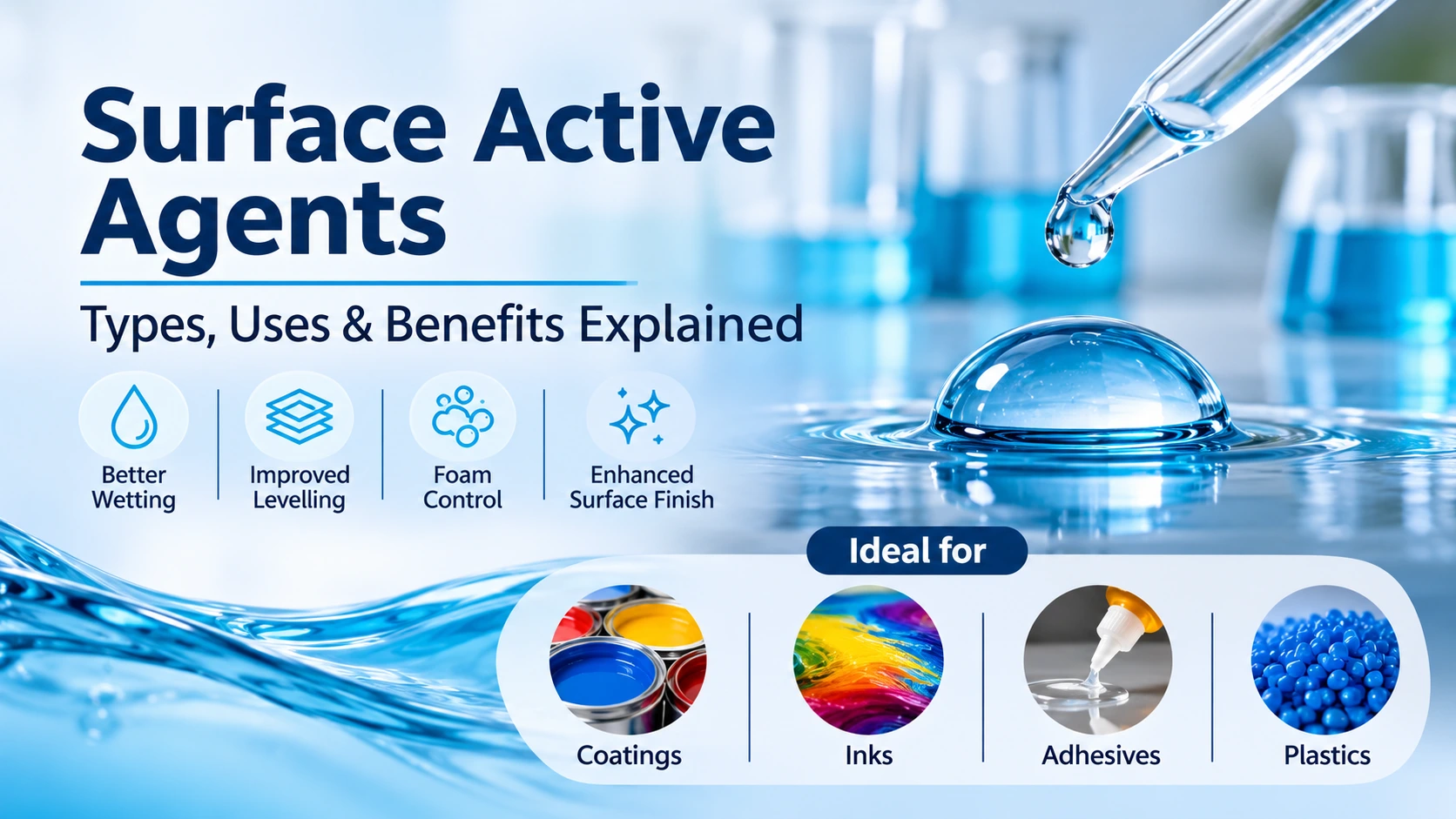
What Are Surface Active Agents? Types, Function & Industrial Applications Explained
Key Highlights
- Surface active agents help control how liquids spread and interact with solid surfaces.
- They can improve wetting, flow, levelling, slip, dispersion and foam control.
- Different chemistries suit different coating, ink, adhesive and industrial systems.
- Silicone-based, fluorocarbon-based, non-silicone and multi-functional additives serve different formulation needs.
- Correct selection depends on the formulation, substrate, application method and required surface properties.
- Poor selection or overuse can cause issues such as foam; poor recoat ability or surface defects.
Understanding Surface Active Agents
Surface performance can affect how an industrial product looks, spreads and behaves during use. A coating may have the right resin and pigment but still show craters, pinholes or uneven flow. An ink may struggle to wet a substrate. An adhesive may not spread evenly.
This is where surface active agents become important.
These additives influence surface tension and the interaction between different phases, such as liquid and air or liquid and solid. This helps formulations spread more evenly and reduces unwanted surface defects. The American Coatings Association also notes that surfactants are used to lower surface tension and improve pigment and substrate wetting in coatings.
In industrial formulations, they may support several functions. These include:
- Wetting
- Levelling
- Foam control
- Slip improvement
- Surface defect prevention
- Dispersion
- Surface appearance
- Adhesion and spreading
The exact function depends on the chemistry and the formulation in which the additive is used.
How Do Surface Active Agents Work in a Formulation?
At a basic level, a surfactant interacts with an interface. This may be the boundary between a liquid and air or between a liquid and a solid.
Many surfactant molecules have both water-attracting and water-repelling parts. Their structure allows them to position themselves at interfaces and change surface behaviour.
For industrial coatings, this can make a practical difference.
Imagine a coating being applied to a metal panel. If the coating does not wet the surface properly, it may pull away from certain areas. This can lead to craters, fisheyes or uneven coverage. A suitable additive can help the coating spread across the substrate more effectively.
The same principle applies during pigment dispersion. Proper wetting helps the liquid interact with pigment particles during processing.
However, more additive does not always mean better performance. The type and dosage must match the formulation. Excess surfactant can sometimes affect water resistance, foam behaviour or other film properties.
Major Types Used in Industrial Formulations
Not all surface additives chemicals perform the same function. Their chemistry and compatibility can vary widely.
The main types used in industrial applications include:
| Type | Common Role | Typical Applications |
| Silicone-based agents | Slip, wetting and levelling | Automotive and high-gloss coatings |
| Fluorocarbon-based agents | Surface control and low surface tension | Specialty coatings and inks |
| Non-silicone agents | Wetting, levelling and foam control | Water-based systems |
| Multi-functional additives | More than one surface function | Plastics, inks and coatings |
Silicone-based agents can improve slip and levelling. Some can also help reduce surface defects and improve gloss or mar resistance.
Fluorocarbon-based chemistry can offer strong surface effects, but its suitability depends on the application and environmental requirements.
Non-silicone options are often considered where compatibility, foam control or specific formulation requirements are important.
Multi-functional additives combine two or more functions. For example, one additive may support wetting, dispersion and foam control.
Key Functions of Surface Additives
The role of surface additives goes beyond improving appearance. They can affect processing as well as the final product.
1. Better Wetting
Wetting allows a liquid formulation to spread across a substrate or interact with particles more effectively.
Poor wetting can lead to:
- Uneven coverage
- Craters
- Poor pigment wetting
- Reduced adhesion
- Surface gaps
A suitable additive can lower surface tension and help the formulation cover the target surface more evenly.
2. Improved Levelling
Levelling helps a wet coating form a more uniform film after application.
This is useful where a smooth finish is important. It can help reduce visible surface variations and improve the appearance of the dried coating.
3. Foam Control
Mixing, pumping and spraying can introduce air into liquid formulations. Excess foam can create bubbles and pinholes.
Surface-active technologies can support foam management when correctly selected. The American Coatings Association notes that foam control is especially important in waterborne coatings because trapped bubbles can affect the final film.
4. Slip And Surface Feel
Some additives alter the surface friction of a dried film. This can improve slip and may support resistance to scuffing, blocking or abrasion in suitable systems.
5. Surface Defect Control
Cratering, crawling and orange peel can reduce the quality of a finished surface.
Surface control additives can help manage these problems by changing the way the liquid film flows and interacts with the substrate.
Where Are Surface Active Agents Used?
The use of surface property enhancement agents spans several industrial sectors. Their role changes according to the product and processing method.
Paints And Industrial Coatings
Coatings are one of the most important application areas.
These additives can help with:
- Substrate wetting
- Flow and levelling
- Gloss
- Crater prevention
- Foam management
- Surface uniformity
Water-based coatings can be particularly sensitive to surface tension because water has relatively high surface tension. Surfactants can therefore help improve both pigment and substrate wetting.
Printing Inks
Inks must spread evenly and form consistent films on different substrates.
Surface active agents can support:
- Better printability
- Uniform coverage
- Improved wetting
- Controlled flow
- Colour consistency
The correct additive can be especially useful when an ink must work across substrates with different surface characteristics.
Adhesives And Sealants
Adhesives need good contact with the substrate before bonding can occur.
A suitable surface treatment agent can improve spreading and help the adhesive make more consistent contact with the target surface.
This does not replace the need for suitable resin chemistry or substrate preparation. Instead, it supports the formulation’s surface behaviour.
Plastics And Masterbatches
In plastics processing, surface behaviour can affect release, appearance and uniformity.
Certain additives can support smoother processing and improve surface properties. Their suitability depends on the polymer, processing conditions and final application.
Paper And Packaging
Paper coatings and packaging systems often require controlled wetting and smooth coverage.
Surface additives can help improve coating spread and substrate interaction. They can also support the appearance of the final coated surface.
Textiles And Leather
Surface-active technologies are also used in textile and leather finishing.
They can support:
- Even treatment
- Better spreading
- Surface uniformity
- Anti-static performance in suitable systems
How To Select the Right Surface Treatment Agent
Choosing a surface treatment agent should start with the formulation problem rather than the product name.
A useful selection process includes five checks:
1. Identify the main issue:
Is the problem poor wetting, foam, levelling, slip or surface defects?
2. Check the formulation:
Consider the resin, solvent or water phase, pigments, fillers and other additives.
3. Study the substrate:
Metal, plastic, glass, paper and other surfaces have different surface energies and compatibility needs.
4. Consider the application method:
Spray, brush, roller, dip and printing processes can create different surface conditions.
5. Test the dosage:
The right concentration matters. Too little may not solve the problem, while too much can create new formulation issues.
This approach is particularly important for industrial buyers because additive selection can affect both product quality and production efficiency.
What Should Industrial Buyers Look For?
Industrial buyers evaluating surface additives chemicals should look beyond price alone.
A practical checklist includes:
- Consistent batch quality
- Clear technical specifications
- Compatibility with the intended formulation
- Suitable performance at the required dosage
- Reliable supply
- Technical support
- Storage and handling information
- Regulatory and environmental requirements
- Application-specific testing
Working with experienced surfactant suppliers in India can also help manufacturers compare grades based on their actual formulation needs.
This is important because two additives with similar broad functions may behave very differently in the same coating or ink.
For a broader look at how supplier choice affects batch consistency, read our guide to how to choose the right surfactant supplier .
Why Correct Additive Selection Matters
The value of surface property enhancement agents is not limited to appearance.
A well-selected additive can help improve processing, surface quality and formulation stability. It can also reduce defects that may otherwise result in rework or product rejection.
At the same time, additives must be treated as part of the complete formulation. A change in resin, pigment, solvent, substrate or application method may require the additive package to be reviewed.
For this reason, testing should be part of the selection process rather than relying only on a generic product description.
The American Coatings Association highlights how surface wetting, foam control and flow additives must be carefully balanced in waterborne coatings to achieve the required performance.
Making Surface Performance A Formulation Priority
Surface behaviour can influence the quality, appearance and performance of industrial products. Surface active agents help formulators control this behaviour by supporting wetting, levelling, slip, dispersion and foam management.
The best choice depends on the chemistry, substrate, process and final performance target. A suitable surface treatment agent can solve a specific formulation issue, but it should be selected and tested as part of the complete system.
At Classic Solvents, we focus on helping industrial customers identify suitable additive solutions for their formulation requirements. We work with established chemical supply networks and provide application-focused support for different industrial needs. Our range covers surface control technologies for coatings, inks, adhesives and other applications. We also assess factors such as compatibility, surface tension, foam sensitivity and desired levelling before recommending a suitable option.
If you are evaluating surfactant suppliers in India, speak to our team about your application and surface performance requirements. We can help you identify suitable surface additives for your formulation and support the next stage of product evaluation.
