

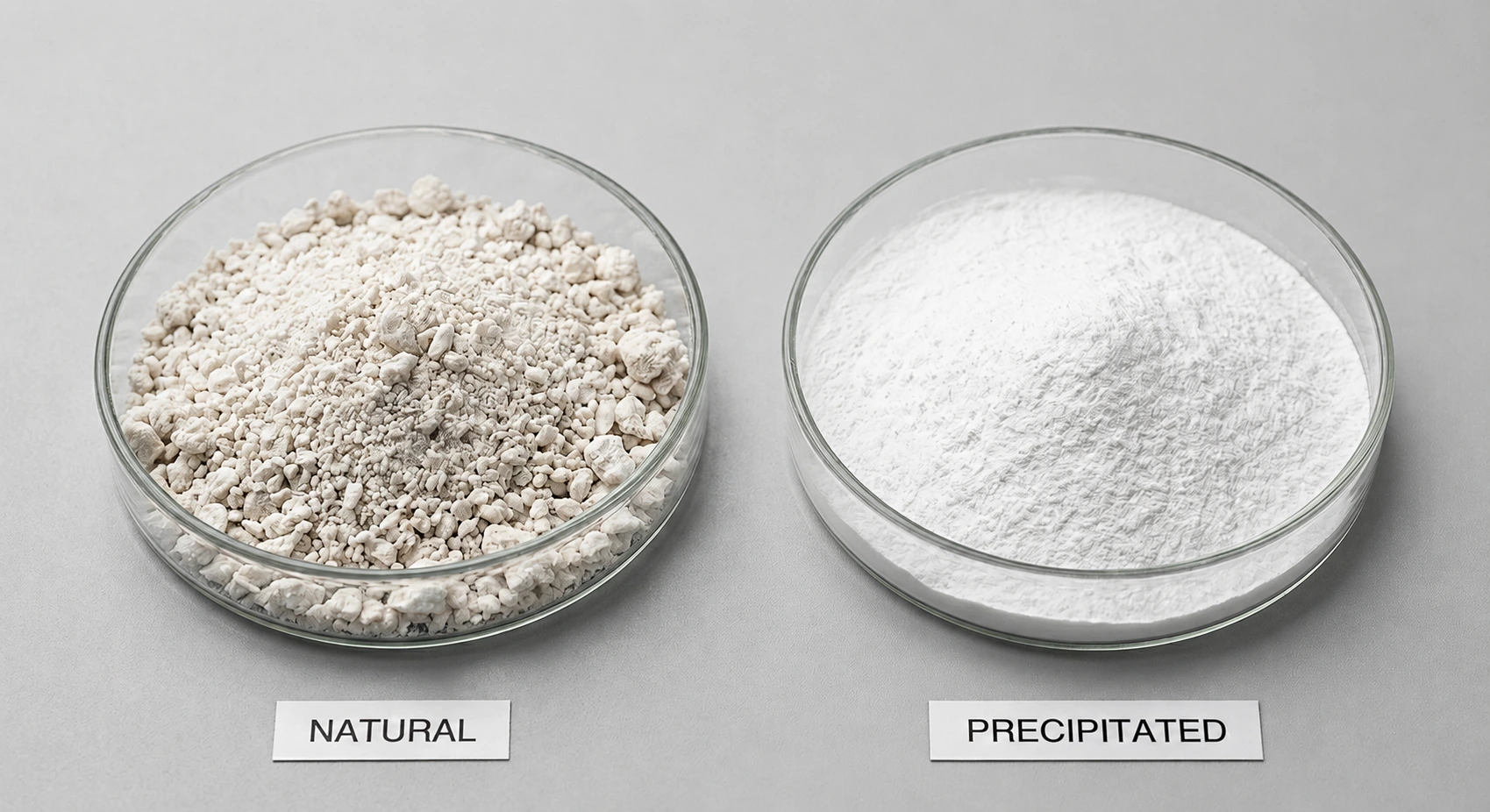
Precipitated Barium Sulfate vs Natural Barium Sulfate: Key Differences & Applications
Not sure whether natural or precipitated barium sulfate is the right choice for your application? Understanding their differences can help you select the right grade for better performance, quality, and value.
Barium sulfate is one of the most widely utilised minerals in industry, incorporated into paints, coatings, plastics, rubber, ink, and construction goods. It helps enhance the quality and performance of the products.
It is important to note that these minerals differ from one another. The major difference is that they exist as natural and precipitated barium sulfates. They both have similar uses in industry, although their properties and performance vary slightly.
Knowing about their characteristics might be beneficial in the future when selecting the material to utilise. Below, we will discuss their main features and areas of use.
What Is Barium Sulfate and Why Is It Used in Industries?
Before comparing the two types, it is important to understand why barium sulfate is widely used across industries.
Common Benefits of Barium Sulfate
- Improves whiteness and brightness
- Enhances opacity and coverage
- Provides good chemical stability
- Improves durability of finished products
- Helps achieve a smoother surface finish
Because of these properties, barium sulfate is used in a wide range of industrial applications.
| Industry | Common Use |
| Paints & Coatings | Improves finish and coverage |
| Plastics | Enhances appearance and strength |
| Rubber | Acts as a functional filler |
| Printing Inks | Supports colour performance |
| Construction Materials | Improves product quality and durability |
Understanding Natural Barium Sulfate
Natural barium sulfate is extracted from mineral deposits and processed for industrial applications. It is widely used in applications where cost-effectiveness and bulk usage are important.
| Feature | Natural Barium Sulfate |
| Source | Derived from mineral deposits |
| Purity | Moderate |
| Particle Size | Less uniform |
| Cost | Generally more economical |
| Usage | General industrial applications |
Natural barium sulfate is commonly chosen for large-volume uses where extremely high purity or exact particle size control are not essential.
What Is Precipitated Barium Sulfate?
Unlike natural grades, precipitated barium sulfate is produced through a controlled chemical process. This allows manufacturers to achieve higher purity and more uniform particle size.
Key Characteristics
- Higher purity levels
- Better particle size control
- Improved consistency
- Enhanced brightness
- Suitable for premium applications
Because of these properties, precipitated grades are often used in applications where product appearance, performance, and consistency are critical.
Precipitated vs Natural Barium Sulfate: Side-by-Side Comparison
The table below highlights the main differences between the two forms of barium sulfate.
| Parameter | Natural Barium Sulfate | Precipitated Barium Sulfate |
| Source | Mined from natural deposits | Produced through a chemical process |
| Purity | Moderate | Higher |
| Brightness | Good | Higher |
| Particle Size | Less uniform | More uniform |
| Consistency | Varies by source | Highly consistent |
| Performance | Suitable for general use | Suitable for high-performance applications |
| Cost | More economical | Typically higher |
It all depends on the demands of the finished product. Even though natural grades may be chosen for economically sensitive uses, precipitated barium sulfate is the better choice where higher-quality materials are desired.
Which Industries Prefer Precipitated Barium Sulfate?
The higher purity and controlled particle size of precipitated barium sulfate make it a preferred choice for applications where consistency and product appearance are important.
- Paints and Coatings
In the paints and coatings application segment, precipitated grades help improve whiteness, gloss, and surface finish. These grades are preferred when manufacturers aim to produce high-quality coatings.
- Plastics and Masterbatches
Plastic makers rely on precipitated barium sulfate to facilitate better dispersion. Controlling the particle size of precipitated barium sulfate can also ensure that the final plastic products look good.
- Printing Inks
Consistency is very important when dealing with printing inks. Precipitated grades help improve consistency during the formulation process.
- Speciality Industrial Products
Industries producing high-performance or speciality products often prefer precipitated grades for their higher purity and consistent quality standards.
When Natural Barium Sulfate Is the Better Choice
While precipitated grades offer several advantages, natural barium sulfate remains a practical option for many industrial applications.
- Cost-Sensitive Manufacturing
For manufacturers looking to optimise material costs, natural barium sulfate can be an economical option. Since barium sulphate price is influenced by factors such as purity and processing methods, natural grades are often preferred for budget-sensitive applications.
- General Industrial Applications
There are many instances in which industries do not require very high purity or very fine particle-size control. For such purposes, the use of natural-grade barium sulfate is sufficient for performance without increasing material cost.
- High-Volume Production
Manufacturers that use a high volume of filler and extender may opt for natural grades because of their relative cost-effectiveness.
Again, it depends on what is needed in terms of performance and cost.
Factors That Influence Barium Sulphate Price
The barium sulphate price can vary depending on several factors. Understanding these factors helps buyers make informed sourcing decisions and select the right grade for their application.
- Purity Level
Higher-purity grades generally require additional processing and quality control, which can increase the overall cost.
- Manufacturing Process
Natural and precipitated grades are produced differently. Since precipitated barium sulfate is produced through a controlled manufacturing process, it is typically priced higher than natural grades.
- Particle Size Requirements
The product may require small particle sizes and consistency, which in turn can affect prices.
- Order Quantity
Purchasing products in bulk can be more cost-effective than buying in small amounts.
- Market Demand and Supply
Factors such as raw materials, shipping, and industry demand will determine the market price of barium sulfate.
Choosing the Right Grade for Your Application
Selecting the right barium sulfate grade starts with understanding your product requirements. A grade that works well for one industry may not be the best fit for another.
- Where high purity, higher brightness, and greater consistency are needed, precipitated barium sulfate may be more suitable. It is used extensively in high-end paints, plastic products, ink and speciality goods.
- On the other hand, if the focus is on cost-effective production and general industrial use, natural barium sulfate can provide reliable performance while helping manage material costs.
Before making a decision, manufacturers should evaluate factors such as product specifications, quality expectations, production volume, and budget. Choosing the right grade helps ensure both product performance and long-term value.
Finding Reliable Barium Sulfate Suppliers
Choosing the right supplier is just as important as selecting the right grade. Reliable barium sulfate suppliers can help manufacturers maintain product quality, ensure timely deliveries, and avoid supply-related challenges.
When evaluating suppliers, consider the following:
- Consistent product quality across batches
- Availability of both natural and precipitated grades
- Technical support for application-specific requirements
- Reliable inventory and delivery capabilities
Quality documentation and product certifications
A dependable supplier should be able to understand your industry requirements and recommend the most suitable solution based on performance and budget needs.
Selecting the Right Barium Sulfate for Better Results
Both natural barium sulfate and precipitated barium sulfate offer unique advantages depending on the application. If you’re still unsure where to start, revisit the basics in our beginner’s guide to barium sulfate before making your final choice. By understanding these differences, manufacturers can make more informed sourcing decisions and achieve better results in their final products.
At Classic Solvents, we help industries source high-quality barium sulfate solutions for a wide range of applications. Whether you require natural grades for cost-effective production or precipitated grades for enhanced performance, our team can help you find the right fit. Contact us to discuss your requirements and discover the most suitable solution for your business.
